
Snapshot
| Role | Scope | Year | Platform |
|---|---|---|---|
| UI/Product Designer & Developer | Product concept, interaction design, frontend and backend implementation | 2023-2024 | Web |
Challenge
Most wallpaper websites were overloaded with ads, misleading download flows, and inconsistent quality controls. The browsing experience felt noisy and untrustworthy.
Objective
Build a clean, ad-free, high-quality wallpaper platform with simple navigation and fast download access.
Stack
- Figma for wireframes and interaction prototypes
- Next.js for frontend and backend delivery
- Media optimization strategy focused on fast visual loading
Product Direction
- Designed WALLPAPERSOCIETY as a clean, trust-first alternative to ad-heavy wallpaper platforms.
- Mapped the full browse-to-download journey and removed non-essential steps.
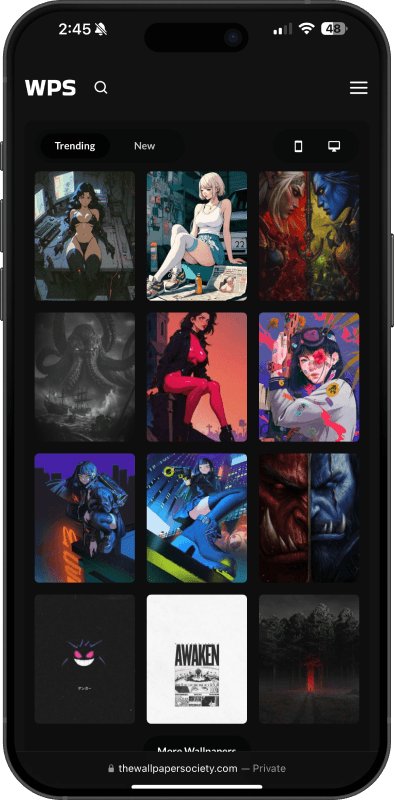
- Prioritized content-first layouts so wallpapers remain the visual focus.
Design Constraints
- This was my first 0-100 design and development project with no prior Figma or Next.js knowledge.
- Delivered solo over a 1.5-year learning and build cycle.
- Balanced learning foundational product and engineering skills while keeping product quality moving forward.
Key UX Decisions
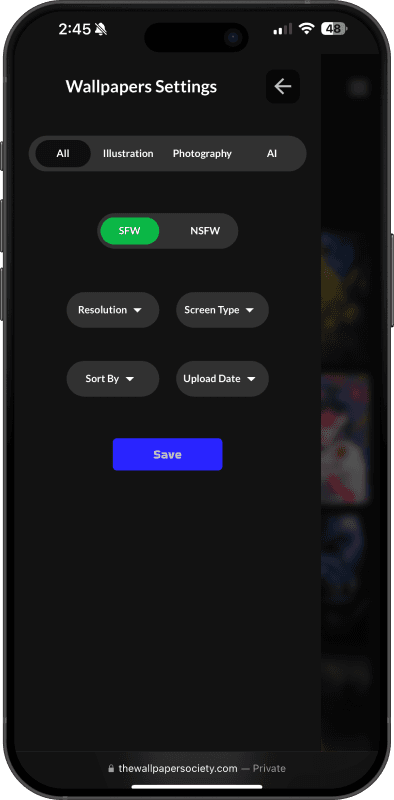
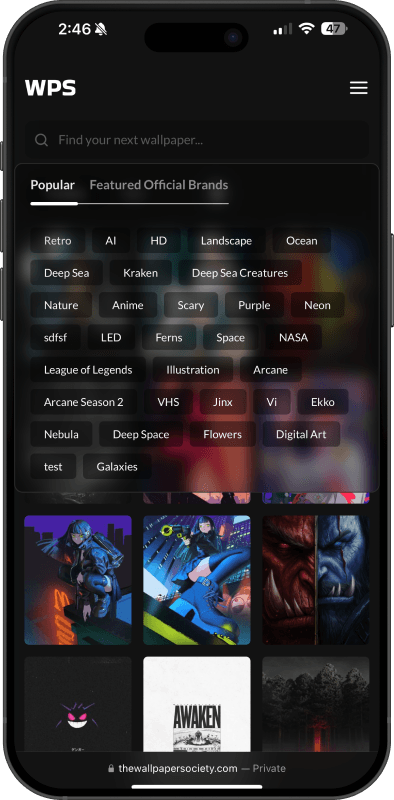
- Kept interaction patterns predictable across category, detail, and download states.
- Reduced visual noise using clear hierarchy and minimal interface chrome.
- Tuned spacing and typography for fast scanning on desktop and mobile.
System Decisions
- Implemented with Next.js to unify frontend and backend delivery in one maintainable codebase.
- Built reusable UI components to keep visual consistency while scaling content volume.
- Structured data and media handling for smooth browsing and reliable download interactions.
Build Notes
- Delivered end-to-end solo across product direction, UX/UI, and engineering.
- Used the project as a full-cycle training ground while still shipping a real public product.
- Kept architecture straightforward so new features can be layered without major rewrites.
Outcome Signals
- Delivered a distraction-free experience aligned with the core product promise.
- Improved usability by simplifying navigation and reducing interaction friction.
- Established a reusable product base that can support new content and features.
V1 Scope Decisions
- Focused v1 on core web browsing and download reliability first.
- Deferred native desktop app work and advanced wallpaper utilities until the core platform stabilized.
Next Phase
- Launch dedicated native applications for Linux, Windows, and macOS.
- Add utilities such as automatic wallpaper rotation and animated wallpaper support.
- Expand community-focused wallpaper tools beyond static browsing and downloads.
Reflection
WALLPAPERSOCIETY was my first full design-to-development project, from 0 to 100%.
I intentionally left some defects, errors, and design flaws visible in the product as a personal marker of where I started and how much I have learned since.
This project established the foundation of my workflow today: clearer architecture, stronger interaction logic, and faster iteration with better product judgment.
Snapshot
| Role | Scope | Year | Platform |
|---|---|---|---|
| UI/Product Designer & Developer | Product concept, interaction design, frontend and backend implementation | 2023-2024 | Web |
Challenge
Most wallpaper websites were overloaded with ads, misleading download flows, and inconsistent quality controls. The browsing experience felt noisy and untrustworthy.
Objective
Build a clean, ad-free, high-quality wallpaper platform with simple navigation and fast download access.
Stack
- Figma for wireframes and interaction prototypes
- Next.js for frontend and backend delivery
- Media optimization strategy focused on fast visual loading
Product Direction
- Designed WALLPAPERSOCIETY as a clean, trust-first alternative to ad-heavy wallpaper platforms.
- Mapped the full browse-to-download journey and removed non-essential steps.
- Prioritized content-first layouts so wallpapers remain the visual focus.
Design Constraints
- This was my first 0-100 design and development project with no prior Figma or Next.js knowledge.
- Delivered solo over a 1.5-year learning and build cycle.
- Balanced learning foundational product and engineering skills while keeping product quality moving forward.
Key UX Decisions
- Kept interaction patterns predictable across category, detail, and download states.
- Reduced visual noise using clear hierarchy and minimal interface chrome.
- Tuned spacing and typography for fast scanning on desktop and mobile.
System Decisions
- Implemented with Next.js to unify frontend and backend delivery in one maintainable codebase.
- Built reusable UI components to keep visual consistency while scaling content volume.
- Structured data and media handling for smooth browsing and reliable download interactions.
Build Notes
- Delivered end-to-end solo across product direction, UX/UI, and engineering.
- Used the project as a full-cycle training ground while still shipping a real public product.
- Kept architecture straightforward so new features can be layered without major rewrites.
Outcome Signals
- Delivered a distraction-free experience aligned with the core product promise.
- Improved usability by simplifying navigation and reducing interaction friction.
- Established a reusable product base that can support new content and features.
V1 Scope Decisions
- Focused v1 on core web browsing and download reliability first.
- Deferred native desktop app work and advanced wallpaper utilities until the core platform stabilized.
Next Phase
- Launch dedicated native applications for Linux, Windows, and macOS.
- Add utilities such as automatic wallpaper rotation and animated wallpaper support.
- Expand community-focused wallpaper tools beyond static browsing and downloads.
Reflection
WALLPAPERSOCIETY was my first full design-to-development project, from 0 to 100%.
I intentionally left some defects, errors, and design flaws visible in the product as a personal marker of where I started and how much I have learned since.
This project established the foundation of my workflow today: clearer architecture, stronger interaction logic, and faster iteration with better product judgment.